Prikaz objav z oznako Regula. Pokaži vse objave

ponedeljek, 5. februar 2018

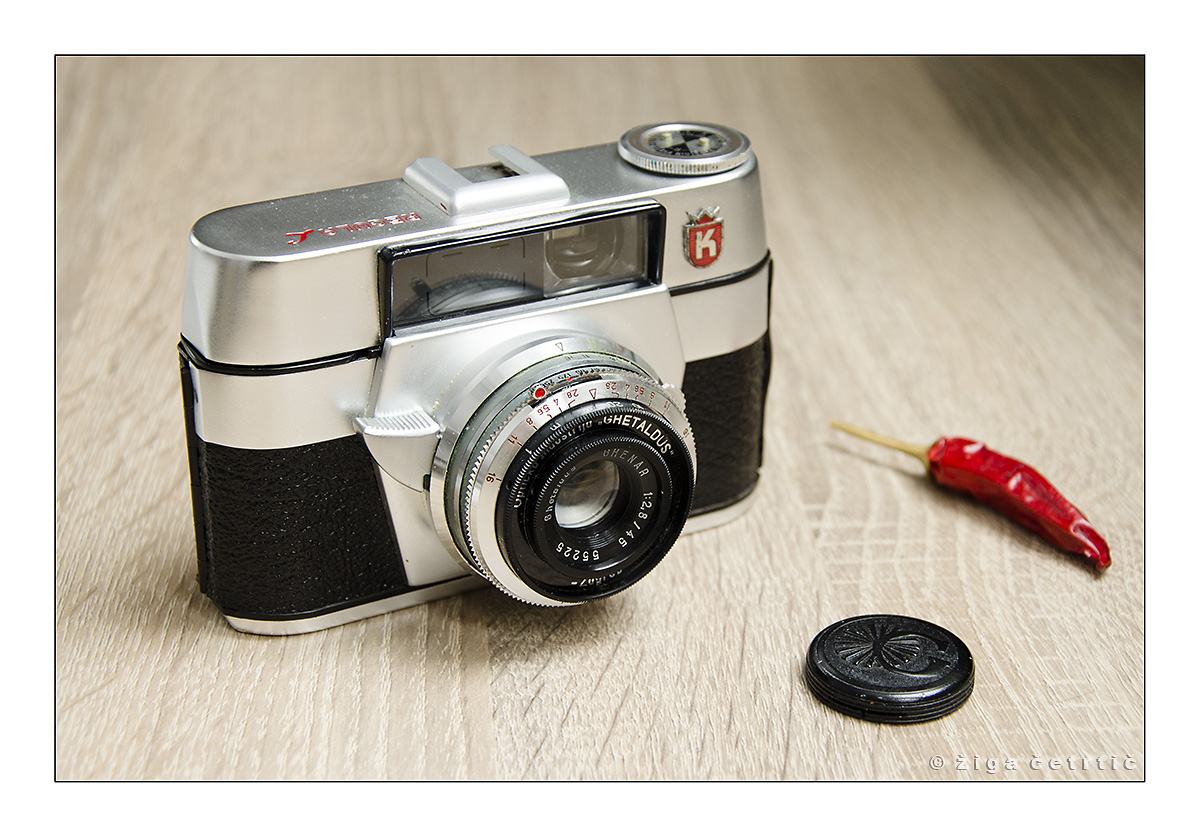
Ghetaldus Zagreb King Regulette

For introduction to Ghetaldus Zagreb cameras, see Ghetaldus Zagreb King Cameras page.
For information on specific camera models, click on these links: Regula IIb, Regula IIIa, Cita III, Regula L, Regulette.

Ghetaldus Regulette is by specification practically identical to Ghetaldus Regula L with Pronto shutter. Main body parts look very similar to Regula L GRL200 and may in some cases be the same, but cosmetic details and weight difference indicates the Regulette uses less metal and was probably targeted to be manufactured for even lover final price. On the bottom there is no leatherette patches and the film speed reminder is omitted. However, Regulette has a film rewind crank which simplifies and speeds up the film changing process. In later variant auto reset frame counter was added.
The Pronto shutter is mounted in a simple and visually non appealing lens barrel with a cheap look and feel aperture adjustment lever. The same Ghetaldus Ghenar 1:2.8/45 lens elements seems to be used as for the Regula L.

From the front the Regulette looks practically the same as Regula L.
  • Viewfinder camera
    • Bright fixed frame in the viewfinder
  • Ghetaldus Zagreb Ghenar lens F/2.8 45 mm
    • 3 elements 3 group
    • Minimum aperture: F/16
  • Pronto shutter
    • 1/250 to 1/30 s + B
    • Self timer
    • Flash synchronization
  • Dimensions
    • Weight: 360 g
    • 125 × 65 × 85 mm 

Based on the serial numbers I collected Regulette was indeed a successor of the Regula L since there is only a short overlap among lens serial numbers between the two models. Cronologically this was the last produced camera by Ghetaldus. All Regulettes I found came with an ever ready case marked "Regula L". The production numbers exceeded the ones of Regula L - 3500 units in comparison to 2500.
   

GRLT100

Silver shutter cocking lever and manual exposure counter reset - or better said exposure counter setting - on the bottom plate. Looks very similar to a late Regula L, but is significantly lighter since even main body frame is built out of plastic. Screws are of a different type (have bigger pitch) to better hold in plastic.
The Regulette has simple lens barrel with a cheap looking aperture setting knob

GRLT200

Black shutter cocking lever that fits the design better than the silver one since the housing rim is black and seamlessly continues. Note that this difference exists also among West Germany made (non Ghetaldus) Regulettes. 

Both showed specimen below with 10 years work at Ghetaldus anniversary engraving. Such gifts were common in the former Yugoslavia. The engraving says: "To <name> <surname> for 10 years at Ghetaldus".


Regulette GRLT200 and GRLT100, both anniversary gifts. The only difference is the film advance knob finish.

GRLT300

Silver shutter cocking lever again, no setting knob and bigger cut-out for the exposure counter. Counter auto resets when back door opens.

GRLT200 (left) and GRLT300 (right) bottom plate with exposure counter comparison.

Regulette Serial Numbers

In the table below there are all serial numbers known to me. In case there is a "*" symbol besides the Variant, the variant is an educated guess due to a lack of data.


Ghetaldus Zagreb King Regula L

For introduction to Ghetaldus Zagreb cameras, see Ghetaldus Zagreb King Cameras page.
For information on specific camera models, click on these links: Regula IIb, Regula IIIa, Cita III, Regula L, Regulette.

Based on specifications and considering only Ghetaldus King cameras, the Regula L seems to be an updated and upgraded Regula IIIa. The lens is still a triplet Ghenar, however, it's 2/3 of the F stop faster with a maximum aperture of F/2.8. The viewfinder has bright frame with a parallax correction mark and is bigger, which looks nice but has a downside in form of a significantly darker view. The shutter moved from the top plate to the lens barrel. The film reminder is still located on the film rewind knob while an exposure counter was moved to the bottom plate of the camera. Film advance and shutter cocking is performed by a lever hidden in the camera body.
Regula L (GRL100 variant) looks somehow more modern with it's clean top and shaped lens plate.
Some Regulas L are equipped with a Prontor-SVS shutter adding the slow speeds up to 1 s, which is significant improvement that would normally cause a model name change - but evidently not in Regula L's case. I have no clue about pricing difference, however, from a small serial numbers sample I gathered Prontor-SVS doesn't seem like an evolutionary change but rather coexistence of higher and lower spec models. Or even an exemption in a small production batch.
  • Viewfinder camera
    • Bright fixed frame in the viewfinder
  • Ghetaldus Zagreb Ghenar lens F/2.8 45 mm
    • 3 elements 3 group
    • Minimum aperture: F/16
  • Pronto shutter (or Prontor-SVS)
    • 1/250 to 1/30 s + B (or 1/300 to 1 s + B for Prontor-SVS)
    • Self timer
    • Flash synchronization (X and M option for Prontor-SVS)
  • Dimensions
    • Weight: 478 g
    • 125 × 65 × 85 mm  


 Regula L with warranty card and receipt. Based on quality control date and receipt date camera sat on the store shelf for half a year prior being sold on April 1962.

Evolution of Ghetaldus Regula L Production

I found Regulas L in a Ghetaldus leather case, but with a Cassar 1:2.8/45mm Steinheil München lens. At first I thought it is a coincidence and someone just replaced the ever ready case, however, I spotted several such specimens on the local internet selling sites. The L series cases are also different compared to the III series, since a hole for the exposure counter is made on the bottom side and "Regula L" is embossed on the upper part. The ones that had lens caps, had Ghetaldus ones. These Regulas L have the older style of the Regula's L body (GRL100) which was made mostly out of metal. One distinguishable feature is less leatherette like surface and more shiny metal on the front side.

It turns out there are also Ghetaldus assembled Rodenstock Trinar Regulas L.
All these Regula L cameras came in Ghetaldus cases with Ghetaldus lens caps, however, only two of them have Ghetaldus lens.
I still couldn't resist to acquire each of these "Ghetaldus Munchen" and "Ghetaldus Rodenstock" Regulas just for sake of comparing them to the Zagreb Regula L.
What I figured out is that front body metal plate design can vary in height. "Ghetaldus Munchen" and "Rodenstock" have red 10 and 3 meters engraving on the distance scale while GRL 100 and GRL 200 have all white. Presence of 20 m engraving also varies. "Munchen" and "Rodenstock" Regula uses decimal point while GRL100 and 200 use decimal comma. Distance style is different among them in decimal number size. "Munchen" and "Rodenstock" have smallest decimal numbers, GRL100 a bit bigger while there is no difference among whole and decimal number on GRL200.

Front body metal plate design: left "Ghetaldus Munchen", middle GRL100 and right GRL200. Note the High vs Low profile of the "Ghetaldus Munchen" and GRL100 lens plate and also metal band on the front that is substituted with leatherette on GRL200.
My theory is that there was a lack of three element 2.8 Ghetaldus lenses when transitioning to or in the middle of Regula L production in Zagreb. Thus imported lenses were used. All in all Regula L with Ghetaldus lens seems to be produced in the lowest number among all Ghetaldus cameras - only approximately 2500 pieces.

Distance engraving styles: left "Ghetaldus Munchen", middle GRL100 and right GRL200.
However, since Ghetaldus isn't mentioned on the "Ghetaldus Munchen" and "Ghetaldus Rodenstock"cameras itself, I don't track these cameras' serial numbers. Still, I noted down variants I spotted during my search for Yugoslav optics equipped King cameras. As seen in the table below, there is no logical connection between properties of non Ghetaldus lens equipped variants besides the fact that all have front metal band.


Bright Frame Finder

Regula L has a variant of the reverse Galilean viewfinder called bright frame finder. Framing assist lines, shaped by the metal mask, are projected to the viewfinder with a help of an ordinary and a semi transparent mirror.

Regula L (GRL100) viewfinder construction.

Underutilized Pronto Shutter

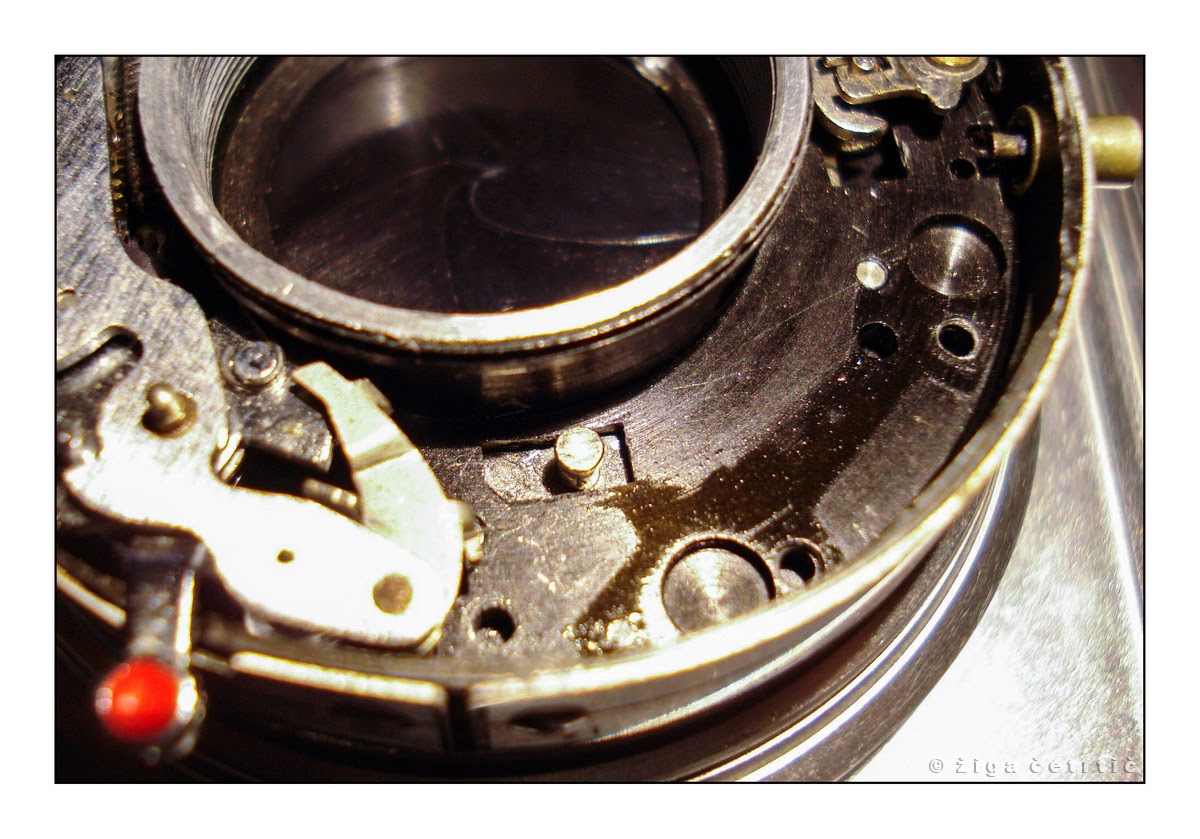
While fixing a Regula L, I discovered that the built in Pronto shutter has a delay mechanism that is in fact never used. Video below clearly demonstrates that slowest speed 1/30 s and B setting don't utilize the delay mechanism. However, when machined metal plate that engages shafts in the shutter when setting different shutter speeds is removed, delay mechanism is engaged and result is cca. 1/2 s exposure. However, due to removed part camera acts as it was set to B, but if shutter button isn't held down, timed exposure of 1/2 s is achieved.
Why didn't they machine the adjustment dial differently? Was camera "crippled" intentionally to not cannibalize sales of higher spec cameras? But which models were such competition? Was Cita III still being sold at the same time? Or was there more expensive GRL300 variant with Prontor-SVS shutter offering shutter speeds from 1 s to 1/500? Based on warranty cards dating I recently learned that Cita III was indeed still sold at the time Regula L was in production. However, it's not necessarily Ghetaldus tactic to hide the spec of the shutter - could be also the shutter manufacturer Gauthier. 


GRL100

Older style of Regula L body - less leatherette, more metal. Body with serial number at the film pressure plate. Bold font on the film memo dial with straight top on the number "3". Bright colored exposure counter set knob. Probably constructed mainly from metal parts. Pronto shutter. 

GRL100 on the left and GRL200 on the right.


GRL200

Regula L GRL200 variant
Pronto shutter, metal aperture knob. Body no longer has serial number. Dark colored exposure counter set knob. Sightly different design of the film chamber than GRL 100 and simplified viewfinder assembly. Viewfinder assembly is not screwed to the body but kept in place by plastic pin and the spring pressure when the top cover is mounted on the camera. Note on the image below that with Regulette viewfinder assembly is screwed in place again which suggests that GRL200 simplification wasn't proven successful.

Viewfinder assembly. Left GRL100, middle GRL200 and on the right Ghetaldus Regulette.

GRL300

Prontor-SVS shutter with shutter speeds from 1 s to 1/300 s, plastic aperture knob. Sample needed.


Regula L Serial Numbers

In the table below there are all serial numbers known to me. In case there is a "*" symbol besides the Variant, the variant is an educated guess due to a lack of data.


Ghetaldus Zagreb King Cita III

For introduction to Ghetaldus Zagreb cameras, see Ghetaldus Zagreb King Cameras page.
For information on specific camera models, click on these links: Regula IIb, Regula IIIa, Cita III, Regula L, Regulette.

The most advanced and feature cramped Ghetaldus camera is the Cita III. The common Regula III family body is fitted with a four element F/2.8 Ghettar lens, a Prontor-SVS shutter with slow speeds down to 1 second, a coupled rangefinder and an uncoupled Gossen light meter. The shutter and aperture settings are coupled to somehow behave like aperture priority mode, keeping the light value setting fixed while changing aperture and shutter speed. I found photos of Ghetaldus Cita III warranty card dated 1962, At that time Regula L, which succeeded Regula IIb and IIIa, was already produced, but spec-wise inferior to Cita III.
  • Rangefinder camera
  • Ghetaldus Zagreb Ghettar lens F/2.8 45 mm
    • 4 elements 3 groups
    • Minimum aperture: F/16
  • Prontor_SVS shutter
    • 1/300 to 1 s + B
    • Self timer
    • X and M flash synchronization
  • Gossen light meter (uncoupled)
  • Dimensions
    • Weight: 630 g
    • 130 ×70 × 85 mm
Cita III, variant GCIII100
On the focusing rim there are plastic ears that seems to aid grip while focusing. These ears have tendency to fall off, thus it's common to find Citas without them.
Known serial number range suggests there were a bit more than 2000 cameras produced. Variants are hard to define due to Ghetaldus Cita's scarcity and what seem to be a totally random pattern in differences. I came across 3 examples and all are different. Additionally from what is described below, distance scale engraving thickness varies among them.

Ghetaldus Cita III box with partially peeled off top layer showing another similar layer. Maybe repurposed IIb or IIIa box?

GCIII050

Two concentric lens nameplates: the outer ring with “Optička industrija "GHETALDUS" –Zagreb-” and the inner ring with “-Ghetaldus- GHETTAR 1:2,8 / 45” engraving.  A plastic aperture couple knob. The Gossen light meter with low profile cover hinges. Uneven spaced stripes on the rewind knob (the same style rewind knob as on the Regula IIb). Name engraving with roman number III that are done with single stroke. Came with interesting snap-on light meter diffuser.

GCIII050 with light meter diffuser and original box in the background.

GCIII100

Same as GCIII50 but with metal aperture couple knob. The Gossen light meter with rectangular hole on the bottom side of the cover - probably wrong setting of the tooling resulted in a hole instead of embossing. Even spaced stripes on the rewind knob (the same style rewind knob as on the Regula IIb). Roman number III with little separations between I (not a single stroke).

GCIII200

Same as GCIII100, but again with plastic aperture couple knob. Higher profile Gossen light meter cover hinges, uneven spacing on the film rewind knob. Finer teeth on the film counter dial, slightly different film advance lever handle knob (different inner circle diameter).

Comparison between GCIII100 and GCIII200 variants.

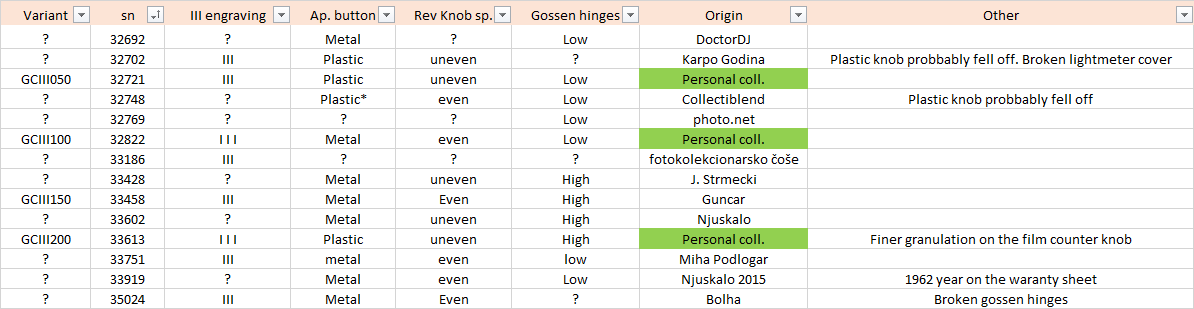
Cita III Ghetaldus Serial Numbers

In the table below there are all serial numbers known to me. In case there is a "*" symbol besides the Variant, the variant is an educated guess due to a lack of data.


Ghetaldus Zagreb King Regula IIIa

For introduction to Ghetaldus Zagreb cameras, see Ghetaldus Zagreb King Cameras page.
For information on specific camera models, click on these links: Regula IIb, Regula IIIa, Cita III, Regula L, Regulette.

The only functional difference compared to Regula IIb is the film speed memo on the rewind knob. Thus it is even more interesting that both models were produced simultaneously and I would really like to know what the original price difference of the mentioned models was. Other than that, the Regula IIIa looks a bit neater due to the black King logo and black paint filled stripes on the front plate.
  • Simple viewfinder camera
  • Ghetaldus Zagreb Ghenar F/3.5 45 mm lens
    • 3 elements in 3 groups
    • Minimum aperture: F/16
  • Pronto shutter
    • 1/200, 1/100, 1/50, 1/25 + B
    • Self timer
    • Flash synchronization 
  • Dimensions
    • Weight: 490 g
    • 130 ×70 × 85 mm

Regula IIIa, variant RIIIa150.

GRIIIa050

“Ghetaldus-Zagreb GHENAR 1:3,5 f=4,5cm AR“ engraving on the lens name plate, conical shape of the lens focusing part. A diamond shaped indicator of selected distance and shutter speed, the “20” m distance engraved on the lens. The film speed reminder on the rewind knob. Strap lugs. With body serial number and an engraved exposure counter. Sample needed.

GRIIIa100

Same as GRIIIa050, but with printed exposure counter and without body serial number. Sample needed.

GRIIIa150

Same as GRIIIa100, but without strap lugs.

GRIIIa200

“Ghetaldus-Zagreb GHENAR 1:3,5/45“ engraving on the conical lens name plate. The focusing part is barrel shaped, still with the “20” m distance engraving. Two triangles indicating selected shutter speed and distance respectively. The red dot on the shutter speed rim located on a flattened surface (previous version has recession between two teeth painted red). Slightly different button on the film advance handle. No strap lugs.

GRIIIa225

“Ghetaldus-Zagreb GHENAR 1:3,5/45“ engraving on the straight flat lens name plate. Otherwise same as GRIIIa200.


GRIIIa250

Same as GRIIIa200, but without the “20” m distance engraving.

GRIIIa300

Same as GRIIIa250, but Roman characters on the camera name plate further apart.

Comparison between GRIIIa150 and GRIIIa300 variant.

Regula IIIa Ghetaldus Serial Numbers

In the table below there are all serial numbers known to me. In case there is a "*" symbol besides the Variant, the variant is an educated guess due to a lack of data.


Ghetaldus Zagreb King Regula IIb

For introduction to Ghetaldus Zagreb cameras, see Ghetaldus Zagreb King Cameras page.
For information on specific camera models, click on these links: Regula IIb, Regula IIIa, Cita III, Regula L, Regulette.

The KING Regula IIb actually doesn’t exist in other variant than with Ghetaldus Ghenar lens. The body design clearly resembles Regula III series, thus the naming is a bit strange. On the other hand the shutter and lens assembly seem to come from the King Regula II series, could be even from Regula IIa, which would explain the logic behind the naming.
Regula IIb is the simplest among Ghetaldus cameras, but still offers a flash synchronization, a self-timer, a double exposure prevention and a shutter cocking with a film advance lever. The film counter is of a deducting type.

Regula IIb, variant GRIIb250.
  • Simple viewfinder camera
  • Ghetaldus Zagreb Ghenar F/3.5 45 mm lens
    • 3 elements in 3 groups
    • Minimum aperture: F/16
  • Pronto shutter
    • 1/200, 1/100, 1/50, 1/25 + B
    • Self timer
    • Flash synchronization
  • Dimensions
    • Weight: 490 g
    • 130 ×70 × 85 mm

For the very early examples serial number can be found on the body inside the film chamber, later it was omitted and only the lens serial numbers remained. The same form of the Ghenar lens is found on the Regula IIIa. The serial number sequence is shared among these two models indicating IIb and IIIa were manufactured side by side.

GRIIb050

 “Ghetaldus-Zagreb GHENAR 1:3,5 f=4,5cm AR“ engraving on the lens name plate, conical shape of the lens focusing part. A diamond shaped indicator of selected distance and shutter speed, a “20” m distance engraved on the lens. Engraved exposure counter. Body serial number.

GRIIb100

Same as GRIIb050, but printed exposure counter and without body serial number. Sample needed.

GRIIb200

“Ghetaldus-Zagreb GHENAR 1:3,5/45“ engraving on the conical lens name plate. The focusing part is barrel shaped, still with the “20” m distance engraving. Two triangles indicating selected shutter speed and distance respectively. A red dot on the shutter speed rim located on a flattened surface (previous version has recession between two teeth painted red). Sample needed.

GRIIb225

“Ghetaldus-Zagreb GHENAR 1:3,5/45“ engraving on the straight flat lens name plate. Otherwise same as GRIIb200.

GRIIb250

Same as the GRIIb200, but without the “20” m engraving.

GRIIb275

Even width of the bright stripes on the film rewind knob. Strange front plate finish - looks polished while all other cameras has finely textured finish.

GRIIb300

Same as the GRIIb250, but “II” engraving on the camera name plate with Roman number characters further apart.

GRIIb325 

Same as the GRIIb300 but even width of the bright stripes on the film rewind knob.

Potential additional variants

Additional oddity is the 05625 Regula IIb that has film speed memo on the rewind knob. The film speed memo seems to be the only functional difference among IIb and IIIa, thus I strongly doubt the rewind knob is original on the mentioned camera. Or could it be an assembly mistake?
There seem to be slight changes in arrow on the exposure counter knob, distance scale and DOF engraving style. Some cameras have thicker engraving. Not enough cameras were examined to confirm this isn't a production variation. Production variation is also a knurled focusing rim on the lens that varies in ridge depth and density.

Regula IIb Ghetaldus Serial Numbers

In the table below there are all serial numbers known to me. In case there is a "*" symbol besides the Variant, the Variant was assigned based on an educated guess due to a lack of data.

Seems that a small batch of miss-engraved cameras was made since low serial number really doesn't make any sense for GRIIb300 and GRIIb250.


nedelja, 23. oktober 2016

Ghetaldus Zagreb King Cameras

For information on specific camera models, click on these links: Regula IIb, Regula IIIa, Cita III, Regula L, Regulette.

I admire work that has been done by many camera collectors sharing information about vintage cameras and their variants. Thus I decided it’s time to make a contribution. Luckily there are still an uncovered niches in the camera collecting world and one of them especially interests me – cameras made in (former) Yugoslavia.


Some years ago I stumbled upon a simple camera that didn’t interest me at all until I noticed the engraving on the lens – Ghetaldus Zagreb. Zagreb is the capital city of Croatia, former republic of Yugoslavia and neighbor country of Slovenia, where I come from. 
The company, whose name the lens wears, still exists in Zagreb, Croatia. Unfortunately, It seems that only a prescription glasses selling business survived, but in the golden ages of socialism the company produced optic equipment such as microscopes, prescription lenses and, as it seems, also camera lenses. After the fall of Yugoslavia, Ghetaldus divided into many branches and the production entities slowly went bankrupt.

Ghetaldus produced sports eyewear among other optical products. [1]

Yugoslavia's import duties were very high to encourage domestic production. However, the fact was cleverly turned into profit by some firms with importing partly assembled goods and finishing them inside the country (e.g. some Yugoslav computer manufacturers and TAS Volkswagen factory). Ghetaldus may have establish that kind of business deal with the West German camera manufacturer Regula-Werk King KG that made the camera line named Regula. To which extent the cameras were actually made in Yugoslavia is unfortunately unknown to me. On the bottom of the camera it is actually written "Made in Germany". But the lenses itself are clearly unique, the lens caps and leather ever-ready cases wear Ghetaldus logo, cases even have metal buttons from TKG Ljubljana (Slovenia).


Metal Ghetaldus lens cap with factory logo.

The Model Lineup


So far I have come across the following cameras wearing Ghetaldus lenses (click on a link to open subpage):
•    Regula IIb  
•    Regula IIIa
•    Cita III
•    Regula L
•    Regulette

Regulas IIb and IIIa are kind of easy to find nowadays on a former Yugoslavian territory. They were made in relatively high quantities for such a small market. Serial numbers suggest that altogether cca 13000 of Regula IIb and IIIa cameras were produced.

Advert from 1959 saying: "We are hereby informing all citizens that on June 16th this year the Central national bank released under the number 270/10 an internal guidance to all its subsidiaries saying that Regula cameras belong to a list of products for which buyers may get bank loan. Buy Regula cameras in a stores using bank loans." [2]

It’s much harder to find a Cita III. Probably the camera was far more expensive and thus less popular. Based on serial numbers I recorded it seems not much more than 2000 examples were made. Regula L and Regulette serial numbers shows that there was approximately 2500 and 3500 cameras produced. In my opinion they were introduced too late and never really caught up with East German and Soviet cameras widely available in the sixties across Yugoslavia. However, there were also some Regulas L assembled (or perhaps only imported and equipped with accessories) with german lenses by Ghetaldus factory, as one can find them with Ghetaldus branded lens caps and leather cases.

Regula L given to the Ghetaldus employee at 10 years work anniversary, Ghetaldus pin and keychain.

So far I was able to precisely date three cameras:

  • Regula IIb sn 04183 production date March 10th 1959
  • Cita III sn 33919 production date February 22nd 1962
  • Regula L sn 56454 warranty card date October 16th 1961


In the links provided above you can find model descriptions and my own classification of the variants. Any help is highly appreciated – if you own a camera with Ghetaldus lens, please, share the serial number and the variant with me via the email address below.


Useful Links and image resources


cjs-classic-cameras - website with a lot of King cameras mentioning and showing Ghetaldus IIIa and IIb.

[1] Poster for Ghetaldus, famous Croatian glasses; design by Vladimir Fleck, unknown year. Source: "Good choice", exhibition catalog, examples of commercial advertising from 1950s and 1960s: Marinko Sudac Collection, 2014. Found on Pinterest.
[2] http://jna-sfrj.forum-aktiv.com/t3552p400-slike-iz-ex-yu-drugi-dio-teme

sobota, 12. oktober 2013

King Regula IIb Camera Servicing

King Regula IIb Camera Servicing

The Camera

I came across this camera by coincidence. I bought a small lot of cameras where this one was totally insignificant, until I closely looked at the lens. It's Gethaldus Zagreb Ghenar. The fact that was attractive to me was that it was apparently made in Yugoslavia. Or not?
There can be little found on the internet about this simple machine, however, the company whose name the lens wears still exists in Zagreb, Croatia. It is in a prescription glasses business and one can find information that some other fractions of the once united optical company exist as well. They actually have a lens production facilities so it is possible that the lens isn't just rebadged.
Former Yugoslavia's import duties were very high to encourage domestic production. However, the fact was turned into profit by some firms with importing partly assembled goods and finishing them inside the country. Ghetaldus may have establish that kind of business deal with West German camera manufacturer Regula-Werk King KG that made the camera line named Regula. To which extent the camera was actually made in Yugoslavia is unfortunately unknown to me. On the bottom of the camera it is actually written "Made in Germany".

The Specifications

Regula IIb (or 2b) is a fairly simple viewfinder camera with a Pronto shutter. There is no rangefinder or light meter present. However, the viewfinder is relatively large and bright. The exact production date is unknown to me, but the German Regulas with similar design were produced during 1950s. Actually Regula III line is more similar to IIa than the II line. Yugoslavian Regulas may have been produced later since production may have been moved from Germany like it was done with the Altix made in Sarajevo by the company Zrak. Other specs are as follows:
  • Ghetaldus-Zagreb GHENAR lens 45 mm F/3.5
    • 3 elements in 3 groups
    • Single coated
    • Focus 0.9 m to infinity
    • Minimum aperture F/16
    • 10 aperture blades
  • PRONTO central leaf shutter 1/25 - 1/200 s + B
  • Self timer
  • Flash sync
  • Auto cocking during film advance
  • Double exposure prevention
  • Deducting frame counter
Despite it may look cheap (well, it actually was an entry level camera) it gives a solid feel since it is made mostly out of metal and quiet heavy.

The Problems

Well, it was stuck with self timer set and not moving. I don't have plans on using Regula extensively in the future nor am I delusional about it's performance, value or rarity (despite the fact that its production was localized for sure and thus somehow rare). However, it appeared to me as a nice project that can go wrong without significant loss. And I like to have working cameras in my collection.
On the other hand, Pronto shutters can be found on many other cameras so this information may be usable also for non Regula IIb camera owners.


The Service

For the tools I use you can refer to the Horizont Camera Servicing blog post. Fortunately nothing special was needed for the Regula.
Set the lens to infinity and unscrew the three little screws that can be found on the focusing portion of the lens. The screws are very small and just hold the element in place. There are no threaded holes beneath them since this enables infinity calibration when putting the camera back together.
Unscrew the four screws that hold the metal rim with the engraved shutter speeds and F numbers. It's just a decorative metal plate and removing it is not necessary, but it is easier to clean the lens if removed.
With the focusing rim removed, the front lens element assembly can be freely unscrewed. I suggest you mark the current position and count how many turns are needed to unscrew it entirely.
Beneath is the second lens element that needs to be unscrewed with a spanner wrench.
Once removed the shutter blades shine in all their glory. I was surprised how clean they were and afraid at the same time since it looked like the dirt is not a reason for this shutter malfunction.
The depth of field scale rim can now be freely removed.
At this point I changed her position and started working from behind. There are four screws in the film compartment that hold the metal parts in shape of sleds.
When unscrewed, the sleds can be removed...
... as well as the film plane part that exposes the inner guts of the Regula. Note the cuts in the film plane - they causes an interesting effect on the photo edges.
A film advance mechanism and shutter cocking gears are clearly visible, but our next goal is to remove the third lens element. A spanner wrench is needed again.
In my case, it was very dirty. As you can see there is no need to remove the lens element from the assembly so be careful which nut you attack with your wrench.
Despite the fact that the aperture blades are in a fully open position, the opening is rather small. This shows that the shutter and aperture can fit a much brighter lens than 45 mm F/3.5. And actually once the shutter assembly is removed from the camera body, the aperture can be opened further. To get the assembly out, the ring screw should be removed.
The shutter assembly slides out easily. Our next target is a pin that is stuck into the shutter cocking shaft. I used pliers to get it out. It may go out in one direction easier. Be careful not to bend the shaft. It's best to search for pliers support on the shaft as well. And one other thing - the pin was literally shot out like a bullet in my case and by some freak coincidence it bounced from my forehead and was caught in metal fruit bowl 1.5 m away.
The camera looks very sad without its shutter assembly. On the right there is the shutter cocking and and on the left the shutter release coupling. 
The aperture should be now opened to the position where 3 screws are revealed. But be careful since they are not all of the same length. The third one is longer (on the picture on the left). The aperture rim should be turned further to reveal an additional screw that is the same length as the first two.
And here are the shutter blades. I didn't disassemble the aperture block with my first Regula IIb since there was no need to do that. I only cleaned it from the outside to make sure that no grease would eventually flow to the shutter blades. However, with the second Regula I came across by, the aperture needed disassembly since one leaf fell out of its nesting. But putting it back together was a nerve wrecking procedure.
Here are aperture blades in a company of shutter blades. Notice that there are 7 aperture blades without and 3 with cuts on one side. I have no idea why.
To put the blades back in order, it took many tries. Initial plan was to learn the best procedure and after that repeat it and take photos for the blog. However, once the blades were put back together, I wasn't willing to break them apart again. Instead I wish you good luck and calm hands if you will have to dig into the aperture assembly :) On the photo above I'm not even half way there since the aperture ring with the blades needs to be put in the assembly which is very tricky.
Back to the shutter assembly - I figured out that the shutter moves freely but doesn't stay cocked. Don't be confused by the electrical resistor. It just played a role of a shutter cocking shaft.
Well, I was impressed by the shapes of the aperture blades and this one is dedicated to the former Yugoslavia :)
The shutter blades can be removed without unscrewing the screws that are shown unscrewed here. I screwed that. No harm was done, however. It's now easy to clean the blades if needed.
Turn the assembly around. Notice the oddly shaved off screw. Turn it a bit so that the metal rim can travel past it and unscrew the rim.

Here is a detailed view of the shaved screw that holds the metal rim in position once screwed.

Once the metal plate is removed, the speed selector rim is revealed. On the top part of the image there is a cut off with four steps visible that moves a little shaft up and down and selects the shutter speed with the help of a simple delay mechanism. The long cut off on the left serves as a B shutter selector since it allows longer travel of the shaft that stops the shutter closing until the shutter lever isn't released. When B speed is selected, delay mechanism is actually set at 1/25 s.
Notice the steps cut into the speed selector rim and the small shaft traveling inside it.
When I opened the second Regula IIb I realized that in the first one one part is missing - the shaft visible on above photo. It blocks the use of the self timer when B shutter speed is selected. If it is absent, the B setting with self timer operates like a 1/25 s was selected. This shaft is not held in its place and may fell out of the mechanism during camera disassembly.
Remove the rim and admire the Pronto shutter all naked.
These are the main parts of the mechanism as far as my knowledge goes:
  •  a) Shutter release lever
  •  b) Self timer power spring
  •  c) Self timer mechanism block
  •  d) Self timer lever
  •  e) Shutter delay mechanism block
  •  f) Shutter speed selector shaft
  •  g) Delay mechanism trigger
  •  h) Shutter cocking shaft
  •  i) Rusted trigger shaft that was stuck
And there is my problem - one rusty part. It's underneath its shiny brothers and sisters, but man it is ugly. Interestingly, only one part was evidently made out of other (or lower quality) material and thus got rusty and stuck the whole mechanism. Solution was quick and dirty - WD40.
Once the mysterious cocktail made its job, I started jiggling the parts and found that the self timer was partially stuck as well. Further jiggling helped the WD40 protrude deeper and release it. One shaft at the shutter delay mechanism was out of its place - I guess it was forced out once the shutter was stuck - so it needed to be unscrewed and positioned correctly. There were three small springs misplaced but unfortunately I found the correct positions for only two of them. The third one, shown above, stayed unsolved.
With help of Chris Sherlock's document I discovered the reason for the misplaced third spring. The longer of the four screws that holds the aperture assembly protrudes to the shutter mechanism and supports this spring. To get it back in place, back part of the shutter assembly should be put back together.
When putting the shutter back together, one of the leafs stays at the top of the others. It is not interleaved as is common with aperture blades. Once the aperture assembly is screwed on, the little spring can be put in its place.
Here the protruding screw is visible on the left from the big screw around which the wire spring should be wound.
To set the spring the shutter delay mechanism needs to be removed. It is held in it's place by two different screws. One is visible only when the shutter is cocked.
The other side of the spring should be hooked to the shaft of the shutter blades' ring. On the above image spring holding screw is removed. The little spring helps with closing the shutter, but my camera seemed to work fine even without it.
Other steps of putting the camera together are reversal to getting it apart. Don't screw the shutter assembly covers too tight since the B shutter setting may not work in that case and the shutter speed selector may be stiff.

Be careful not to mess or, even better, check the infinity setting with the ground glass just before mounting the focusing knob on the front lens element assembly.

The Result

And here are some photos taken with the repaired Regula IIb. I find the zig-zag pattern of the picture edges very appealing. They may be a kind of signature of this camera since I haven't seen them elsewhere. The cause is the shape of the light shaft in the film chamber.
Overall the camera now purrs like a kitty, clicks like a mouse and looks very well.

For the end just a little disclaimer: I'm an enthusiast collector of vintage cameras that likes to use them and tries not to spend a lot of money for his hobby. I'm not educated in camera servicing and I have little experience. So if someone that reads this has any comment or suggestion about what I did (wrong) or I should do, please, write a comment.